The moment is the same every year. The days grow longer and brighter, the temperatures slowly rise, and with the first warm rays of sunshine, the desire to get back on your bike grows automatically. Perhaps your bike has been stored in the cellar all winter, protected in the garage, or carefully covered with a tarp. At first glance, everything seems unchanged. The frame looks fine, nothing appears damaged, and there's really nothing stopping you from riding off right away.
But often, after just a few meters, a different feeling sets in. The chain no longer runs quite smoothly, the gears shift sluggishly, and the bicycle feels more cumbersome than remembered. What many don't know: Most problems after the winter break aren't caused by wear and tear, but by invisible dirt.
Old lubricant combines with dust, moisture, and fine metal shavings. This mixture accumulates deep within moving components and affects the entire mechanism long before it becomes visible.
A thorough spring check therefore means much more than just cleaning. It brings your bicycle back into technical balance. In this article, we explain step by step how to properly clean your bicycle, avoid typical mistakes, and why a thorough deep cleaning is the most important start to a relaxed cycling season.
Why the start of spring is crucial for your bicycle
Even if your bicycle was hardly used during the winter months, it doesn't remain technically unchanged. Materials are sensitive to temperature fluctuations, humidity, and long periods of inactivity. Changing temperatures cause condensation, lubricants slowly change their consistency, and the finest dust and abrasion particles tend to settle in precisely the areas where movement later occurs.
These changes happen quietly and almost invisibly. In everyday life, they usually only become noticeable when you're out and about regularly again.
These changes often become apparent when driving without a spring cleaning:
- Gear changes feel imprecise
- Pedals are harder to turn
- Noises occur suddenly
- Wear and tear increases unnoticed.
That's precisely why spring cleaning is such an important time for your bicycle. A thorough cleaning isn't just a cosmetic measure, but genuine technical maintenance. It removes residue, reduces friction, and ensures that all moving components work together smoothly again.
Those who consciously maintain their bicycle at the beginning of the season not only protect individual components, but also noticeably extend the lifespan of the entire drive system.
Properly cleaning a bicycle doesn't start with the frame.
Many people intuitively start cleaning their bikes in the spring by focusing on the most visible dirt. They rinse the frame, remove dust, and perhaps give the handlebars or fenders a quick wipe. Of course, this is all part of maintenance, as a clean bike looks well-maintained and makes a good first impression. However, your bike's true performance isn't just on the surface, but within its internal mechanics.
The heart of every bicycle is the drive system. This is where things work.
- Chain,
- Pinion,
- derailleur pulleys and
- Storage
These components work together constantly to transfer your power to the road as efficiently as possible. Even the smallest deposits can affect this finely tuned interplay. Invisible dirt increases friction, movements are minimally slowed, and with every pedal stroke, energy is lost without you immediately noticing.
That's precisely why it's worth consciously changing your perspective when cleaning your bike. It's not just about making your bike look clean, but about making it ride smoothly, quietly, and precisely again.
Sustainable bicycle maintenance therefore follows a simple but crucial principle.
First technology, then optics.
When the mechanical components are free of deposits, your bicycle runs noticeably smoother, shifts more precisely, and conveys exactly that feeling of lightness that makes for a truly good ride.
These bicycle parts should be cleaned especially thoroughly.
Your bicycle consists of many individual components, but some areas are subject to particularly high stress and significantly determine how easily, smoothly, and precisely your bicycle rides. It is precisely in these areas that dirt accumulates over the winter months, often remaining invisible yet having a major impact on performance.
1. Clean the bicycle chain
The bicycle chain is one of the most heavily stressed components in any bicycle. It is extremely durable.
- lubricants,
- Dust,
- moisture and
- fine metal abrasion
exposed. With each trip, it picks up new particles that become lodged between the individual chain links.
From the outside, the chain may appear quite clean. But what matters is its interior. This is precisely where the greatest wear occurs, because old lubricants mix with dirt to form a viscous mass that acts like a fine abrasive. As a result, the chain runs more slowly, wears out faster, and no longer transmits your power efficiently.
A thorough cleaning of the chain is therefore one of the most effective steps for a noticeably better riding experience.
2. Clean the cassette and sprockets
The cassette and sprockets are directly connected to the chain. Over time, deposits accumulate between the individual sprockets.
- Grease residues,
- dust and
- road particles
These residues alter the contact surfaces between the chain and the sprocket and prevent clean gear changes.
The effect often becomes apparent gradually: the shifting feels imprecise, gears jump slightly or react with a delay. Only a thorough cleaning restores the original precision , because the chain can once again move freely and evenly over the sprockets.
3. Clean the derailleur pulleys
Derailleur pulleys are small components that go largely unnoticed in everyday use, yet have a surprisingly large impact. They guide the chain and ensure that power transmission remains smooth and controlled.
Even minimal dirt noticeably increases resistance. The bicycle suddenly feels more sluggish , even though there is no obvious defect. Cleaning the rollers often makes this feeling disappear immediately, and the bike runs much more quietly again.
4. Clean pedals and screw connections
Also
- pedals,
- axles and
- Screw connections
These are among the most underestimated problem areas. Moisture penetrates small gaps, dirt accumulates, and corrosion can develop over time. These processes are slow and often go unnoticed until components become difficult to move or remove.
Regular cleaning not only protects the function, but also the long-term maintainability of your bicycle.
Many cyclists experience a surprising effect after a thorough cleaning: the bicycle feels quieter, lighter, and significantly more pleasant to ride. Not because anything was repaired, but because all components can function freely again.
Home remedies, water or classic cleaning – where do the limits lie?
For decades, classic bicycle cleaning has been a natural part of maintenance for many. A bucket of water, some cleaning agent, a brush, or a garden hose is often all it takes to visibly remove dust, mud, and road grime. After just a few minutes, the frame shines again, the tires look clean, and the bicycle makes a well-maintained impression.
But this is precisely where the biggest misconception lies. Clean does not automatically mean technically cleaned.
Most traditional cleaning methods only work on the surface. They remove what is visible, but hardly reach the areas where the real problems develop over months. Grease, abrasion, and fine particles tend to accumulate in crevices, joints, and moving parts. There, they often remain even after thorough scrubbing.
Many cyclists are familiar with this phenomenon: the bike looks significantly better after cleaning, but it hardly rides any easier. The reason is simple. The crucial dirt is embedded deeper than brushes or sponges can reach.
Furthermore, well-intentioned cleaning attempts can actually create new problems. High-pressure cleaners force water into bearings and seals, where moisture can cause long-term damage. While aggressive cleaning agents dissolve grease, they also attack sensitive materials, coatings, or seals. What seems effective in the short term can accelerate wear and tear in the long run.
If you still clean your bike using traditional methods, you'll end up with a bike that looks well-maintained on the outside, but whose internal mechanisms continue to operate under increased friction. This is precisely where a shift in thinking begins in modern bicycle maintenance. The result is no longer determined by using as much water or applying as much force as possible, but rather by the ability to clean even hard-to-reach areas gently and thoroughly.
Cleaning a bicycle without a water connection
Not everyone has a garden, a yard, or a dedicated washing area. Especially in urban environments, bicycles are often stored in basements, hallways, on balconies, or in underground garages. This quickly makes traditional cleaning with a hose and plenty of water a challenge. Often, there simply isn't a suitable place to thoroughly clean a bicycle without making a mess or disturbing others.
The consequence is well-known: cleaning gets postponed. People wait for better weather, more time, or the next opportunity to clean outdoors. Meanwhile, deposits continue to accumulate, and the bicycle gradually loses its lightness and efficiency.
Bicycle maintenance is undergoing a fundamental transformation. Modern cleaning is increasingly moving away from traditional rinsing towards controlled, material-friendly methods that work regardless of location. Cleaning now takes place wherever your bicycle is: in the basement, the garage, or right at the workbench.
This is precisely where new solutions are gaining importance. Instead of using water and brushes, more and more cyclists are opting for methods that clean specifically where dirt actually accumulates. Ultrasonic cleaners, for example, allow for the thorough cleaning of individual bicycle parts without a water connection, without splashing water, and without laborious scrubbing. Components such as chains, screws, or derailleur parts can be cleaned in a controlled manner and with particular care for the materials.
The major advantage lies in its practicality for everyday use: maintenance becomes independent of weather, living situation, or available space. Cleaning no longer happens sometime in the future, but regularly and precisely when it is needed.
This makes bicycle maintenance truly compatible with urban life for the first time, and this is exactly what ensures a bicycle that remains reliable, quiet and efficient in the long term.
Why ultrasonic cleaning is particularly effective for bicycle parts
Anyone who regularly maintains their bicycle quickly notices that many types of dirt are only superficially removed with conventional cleaning methods. Especially where components interlock or where movement occurs, mechanical scrubbing reaches its natural limits. This is precisely where our emmi ultrasonic cleaning system demonstrates its exceptional strength.
Unlike manual cleaning, an ultrasonic cleaner doesn't use pressure, brushes, or mechanical friction. Instead, it utilizes a physical principle called cavitation. Millions of microscopic bubbles form in the water bath, implode, and loosen even the finest dirt particles from the smallest crevices. Cleaning doesn't proceed from the outside in, but simultaneously on all accessible surfaces.
This makes a noticeable difference. While brushes only reach visible areas, ultrasound also cleans inner surfaces, joints, and hard-to-reach structures evenly. Grease and oil residues are removed in a controlled manner without unnecessarily stressing materials.
Bicycle parts especially benefit from this method , as many components have complex shapes, tight spaces, or moving elements that are difficult to clean completely by hand. Bicycle chains, sprocket sets, derailleur pulleys, and small metal parts often regain their original smooth operation after ultrasonic cleaning.
The real advantage, however, lies in the combination of thoroughness and gentleness. Less aggressive chemicals, significantly less effort required, and a reproducible cleaning result make ultrasound a modern form of bicycle care that is increasingly used both privately and in workshops.
Which Emmi ultrasonic devices are suitable for bicycle parts?
Not every emmi ultrasonic cleaner is automatically suitable for bicycle parts. The crucial factor is not so much the size of the device itself, but rather the interplay between tank volume, power, and ease of use. Small household cleaners, originally intended for jewelry or glasses, quickly reach their limits when cleaning bicycle components.
For effective bicycle maintenance, the device should offer sufficient space so that components can be fully immersed and the ultrasonic waves can have an even effect.
For hobby drivers and private users
For most bicycle owners, our emmi ultrasonic cleaning devices in the 1 to 2 liter class have proven to be the ideal entry-level option. These devices are compact enough for basements, garages, or hobby rooms, yet powerful enough for a truly deep clean.
Typical everyday applications include:
- bicycle chains
- derailleur pulleys
- Screws and small parts
- pedals
- valves or adapters
A device of this size combines convenience with high cleaning performance and is ideal for anyone who wants to regularly maintain their own bicycle.
For ambitious mechanics or multiple bicycles
Anyone who owns multiple bicycles or performs frequent maintenance will quickly benefit from a larger emmi ultrasonic cleaner . A larger tank volume means fewer individual cleaning steps and saves time in the long run. Multiple components can be cleaned simultaneously, making maintenance significantly more efficient.
Families, clubs, and passionate cycling enthusiasts in particular will discover real added value here.
For workshops, classic cars or frequent users
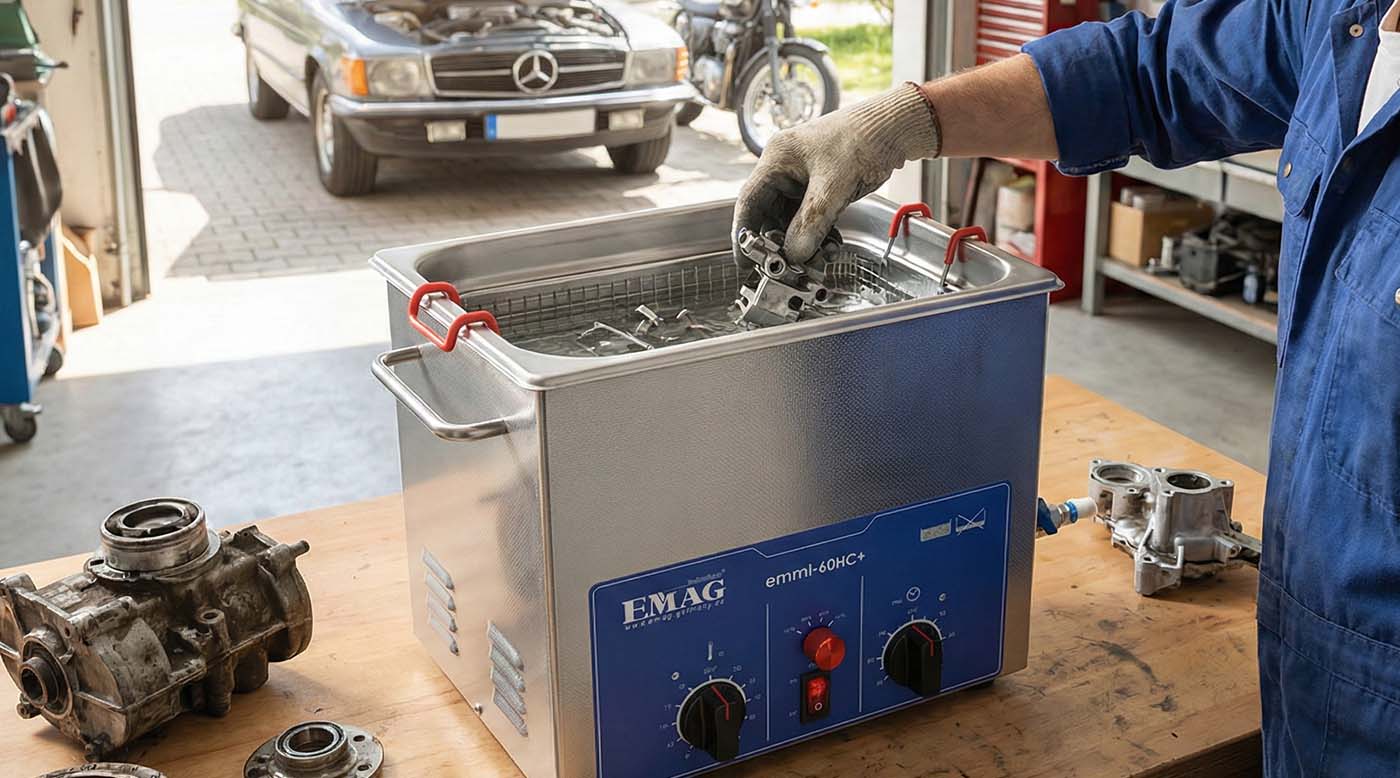
In professional settings , emmi ultrasonic cleaning devices with larger tank capacities are frequently used . These are suitable not only for bicycle parts, but also for numerous other applications in workshops and technical environments.
Typical areas of application include:
- bicycle repair shops
- Motorcycle and scooter components
- Automotive small parts
- Garden tools
- Metal tools and precision parts
A simple rule of thumb has proven effective: choose a size larger. A sufficiently sized device makes the work easier in the long run, expands the range of applications, and makes cleaning significantly more comfortable.
This makes the ultrasonic cleaner not only a tool for bicycle maintenance, but also a versatile helper for everyday technical and workshop use.
Step-by-step guide to thorough bicycle cleaning
- Disassemble the components to be cleaned.
- Remove coarse dirt.
- Prepare for cleaning.
- Select a suitable cleaning concentrate.
- Perform ultrasonic cleaning according to the instructions.
- Dry parts completely.
- Re-lubricate parts if necessary.
- Assemble the parts.
The great advantage of modern cleaning is that technology takes over the time-consuming part and enables consistent results.
Spring is the ideal time to give your bike a real fresh start. A thorough cleaning not only ensures better performance but also more enjoyment while riding.
Modern bicycle maintenance no longer means spending hours cleaning. It means using smart methods that make the job easier and achieve better results. A clean bicycle is easier to ride. And a smoothly functioning bicycle is simply more fun.