Anyone who cycles regularly might know the problem: the pedals no longer turn as easily as they used to, movements feel a bit sluggish, or individual components run less smoothly. Often, the first assumption is that bearings are worn or need to be replaced. In reality, however, something else is often behind it.
Bicycles are exposed to a wide variety of environmental influences daily. Dust, sand, moisture, pollen, road grime, and abrasion constantly get onto moving parts. Pedals, in particular, are among the components that are stressed with every ride. At the same time, there are areas inside that are hardly visible from the outside and are often not reached during normal cleaning.
Over time, deposits can form there, impairing smooth operation. The changes usually occur gradually and are therefore hardly noticeable at first. Those who know the causes can react early and help ensure that pedals and other movable bicycle parts function reliably for as long as possible.
In this article, we explain why bicycle pedals can become stiff over time, what role dirt and deposits play in this, and how the function of movable bicycle parts can be maintained in the long term.
Why bicycle pedals are constantly exposed to stress
Pedals are among the most heavily stressed components of a bicycle. With every ride, they transfer the power of the legs to the drive. At the same time, they are constantly exposed to external influences. Unlike many other components, they are located in close proximity to the road surface and therefore regularly come into contact with dust, dirt, water, and small stones.
Especially in summer, fine dust, pollen, and dry dirt particles often accumulate. In the rain, moisture and splash water are added. Even on dirt roads, forest trails, or gravel paths, new particles constantly get into the mechanism. Some of this contamination remains visible on the surface, while another part gradually penetrates into bearing areas and moving components.
The more frequently a bicycle is used, the greater the stress on the moving parts. Even high-quality pedals are no exception. Lubricants are meant to protect the mechanism, but can also bind fine dust particles. This can lead to deposits over time that impair mobility.
In addition, many riders clean their pedals from the outside, while the actual problem areas remain hidden inside. However, it is precisely there that residues often form, which are later responsible for sluggish movements.
What dirt can accumulate inside
From the outside, bicycle pedals often look much cleaner than they actually are. While coarse dirt is usually quickly removed, fine deposits often go unnoticed. Especially inside the pedals, there are areas where dirt can accumulate for a long time.
The most common contaminants include dust, sand, pollen, grease residues, abrasion, and fine particles from the road. Especially when riding on unpaved roads, tiny dirt particles constantly get into the mechanism. Together with existing lubricants, this creates a mixture that can gradually accumulate in bearing areas and moving components.
Moisture also plays an important role. Rain, splash water, or high humidity can contribute to dirt particles adhering more strongly to surfaces. If the bicycle is then not sufficiently cleaned or dried, the deposits can further thicken.
Many of these residues are not visible from the outside and are therefore often overlooked. Only when pedals turn harder, unusual noises occur, or the movement no longer feels even, does the contamination become noticeable. By this time, the deposits have often already built up over a longer period.
Especially for bicycles that are used regularly, it is therefore worthwhile not only to clean the visible areas but also to pay attention to the components that usually remain hidden.
Why stiff pedals should not be ignored
Initially, stiff pedals seem like a minor comfort issue. In reality, however, they can be an indication that dirt or residues are already significantly affecting the mechanism. Therefore, it is worth taking changes seriously early on.
If pedals can no longer turn freely, the stress on bearings and movable parts increases. The mechanism has to overcome more resistance, which can promote additional wear in the long term. At the same time, the riding experience often changes. Power transfer feels less efficient, and movements can feel unfamiliar.
In addition, deposits rarely disappear by themselves. If they are not removed, further dirt particles often accumulate. This can gradually exacerbate the problems. Many bicycle owners first resort to new lubricant in this situation. This can help in the short term, but does not necessarily eliminate the underlying cause.
Thorough cleaning should therefore often precede re-lubrication. Only when existing residues have been removed can lubricants perform their task optimally again. Acting early can often prevent small impairments from leading to larger maintenance work.
Regular checks help to detect changes in good time and to maintain the functionality of movable bicycle parts for as long as possible.
How ultrasonic cleaning is used for bicycle components
Many bicycle parts have fine gaps, bearing areas, or complex structures that are difficult to reach with conventional cleaning. Especially with pedals, ball bearings, screws, spacer rings, or other metal components, dirt and old lubricant residues can accumulate in places that are almost impossible to reach with brushes or cloths.
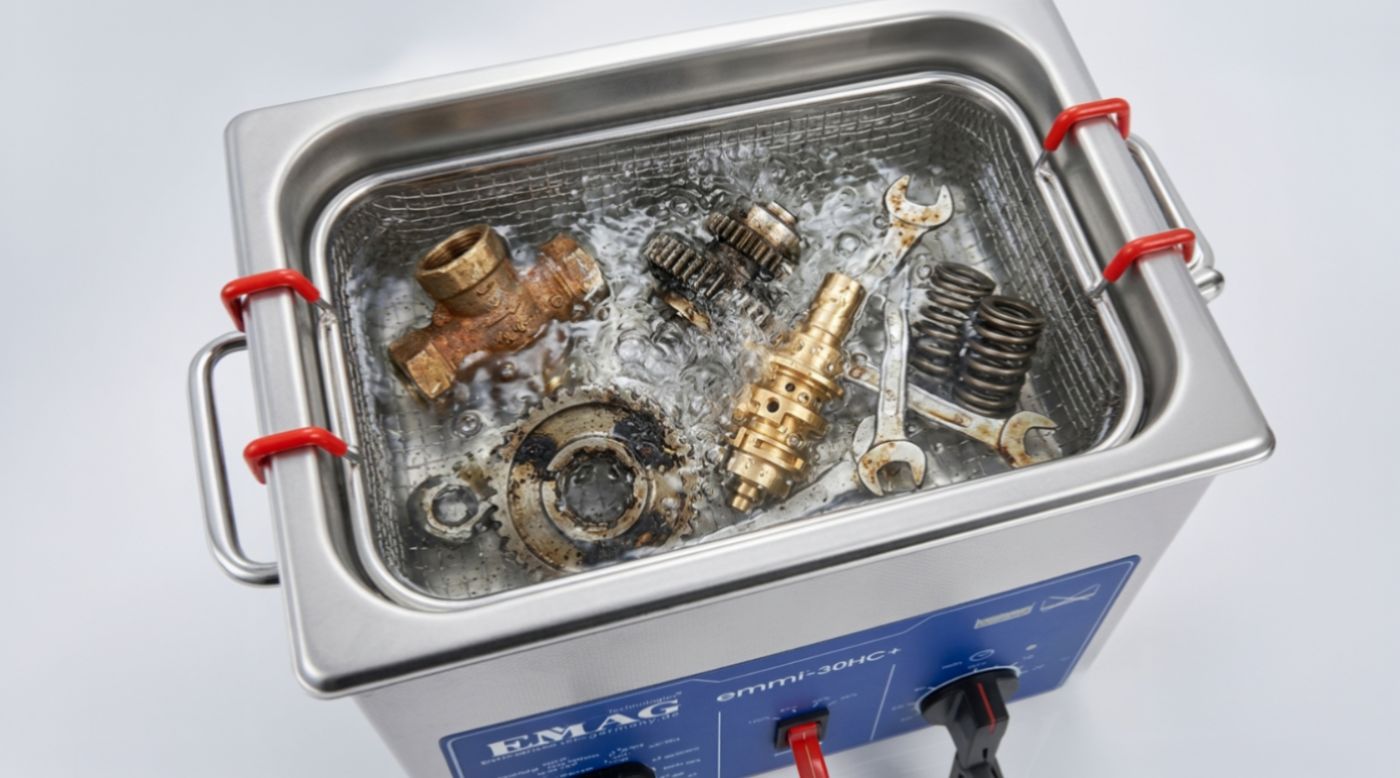
For this reason, ultrasonic cleaning is often used in the maintenance of bicycle components. High-frequency vibrations in a cleaning liquid create tiny bubbles that release energy when they collapse. This process is called cavitation. The resulting forces can help to loosen contamination from surfaces and hard-to-reach areas.
Especially for smaller metal parts and complex components, ultrasonic cleaning can support even cleaning. Many bicycle workshops therefore use this method for disassembled components in which residues have accumulated internally.
For professional applications, systems such as our EMAG ultrasonic cleaners are often used. These devices are used for technical components, tools, and metal components, among other things. However, the suitable cleaning time, temperature, and cleaning fluid always depend on the respective component and its material.
It is important to check before each cleaning whether the respective components are suitable for ultrasonic cleaning. Manufacturer instructions should always be followed. Not every coating and not every material reacts equally to ultrasonic treatments.
How to keep pedals and moving parts smooth for longer
If you want to enjoy your bike for a long time, you should regularly maintain moving components. This is not just about cleaning after a particularly dirty tour, but about continuous maintenance throughout the year.
After riding in the rain, on forest paths, or on dusty routes, timely cleaning is worthwhile. This prevents dirt and moisture from adhering to components for extended periods. It is particularly important to allow moving components to dry sufficiently afterwards.
Regular inspection of pedals, bearings, and other mechanical parts is also useful. Changes in running behavior, unusual noises, or increased resistance can be initial indications that maintenance is required.
Long-term care includes, in particular:
- Regular cleaning after heavy contamination
- Removal of old dirt and grease residues
- Complete drying after cleaning
- Appropriate lubrication according to manufacturer's instructions
- Regular functional check of moving parts
Often, it's not major defects, but small deposits that impair the smooth running of a bicycle. Removing these early can help ensure that components work reliably for longer and maintain their function.
If pedals run harder than usual, it's not automatically a worn bearing or a technical defect. Often, dust, sand, moisture, and lubricant residues accumulate over months in places that are hardly visible from the outside. These deposits can noticeably affect mobility and change the riding experience.
Those who know the typical causes and regularly check movable bicycle parts can detect many problems early on. Thorough cleaning, combined with appropriate care and proper maintenance, supports the functionality of pedals and other mechanical components. Especially for frequently used bicycles, it is worthwhile to take a closer look at the areas that often go unnoticed during normal cleaning. It is often there that the long-term smoothness and reliability of the mechanics are decided.