Many people assume that a tool only needs to be cleaned when there is visible dirt. In fact, however, significantly more deposits often accumulate than are apparent at first glance. Oil residues, fine metal abrasion, dust, resins, greases or lubricant residues can become firmly embedded in small crevices over weeks and months. The consequences often appear insidiously. Pliers no longer grip cleanly, joints move with more difficulty, or precision tools work less accurately than usual.
Especially in workshops, garages, or during regular DIY work, tools are constantly exposed to various stresses. Even high-quality models can lose functionality if dirt is not removed in time. Often, the cause is not wear and tear or material fatigue, but rather residues that impair the mechanics.
Those who understand the background can detect many of these problems early and take targeted countermeasures. This not only keeps tools operational longer, but also makes them work more reliably and precisely.
In this article, we explain why tools can lose precision and function over time, what role invisible residues play, and how the performance of many tools can be maintained in the NL-term.
Why tools lose performance over time
Tools are exposed to different stresses daily. With each use, tiny particles are created that can deposit on surfaces, in joints, or in hard-to-reach places. In addition, there is dust, moisture, lubricants, or residues from materials being processed. Moving tools such as pliers, ratchets, side cutters, or precision instruments are particularly often affected.
A typical example is oily residues. While they are supposed to protect and lubricate moving parts, they also attract dust and dirt. Over time, this creates a tenacious layer that can impair mobility. Fine metal abrasion is also often underestimated. It occurs in many work processes and preferentially accumulates where parts move or rub against each other.
Even the smallest deposits can be enough to affect the function of sensitive tools. Especially with precision tools, changes are often noticed faster than with robust hand tools. The mechanics react less smoothly, gripping surfaces work less accurately, or individual components no longer move as freely as originally intended.
Therefore, it is worthwhile to clean tools not only when obvious problems arise. Regular maintenance can help to maintain functionality and avoid unnecessary wear.
Which residues accumulate particularly often
Many contaminations are not caused by individual large dirt particles, but by a combination of various residues that accumulate over a longer period. This is precisely why they are often overlooked. While coarse dirt is immediately noticeable, fine deposits often remain unnoticed until a tool's function noticeably declines.
The most common causes include dust, oil residues, lubricants, metal abrasion, and material particles from daily work. For example, those who process wood often deal with fine wood dust and resin residues. In metal workshops, on the other hand, tiny metal particles are created, which can settle on surfaces or in moving parts. Adhesive residues, polishing agents, or cleaning product residues can also accumulate over time.
Areas that are hardly reached during normal cleaning are particularly critical. These include joints, threads, springs, bearings, or fine recesses. There, residues can build up layer by layer. From the outside, the tool often still appears clean, while inside, deposits are already present that restrict movement.
A common mistake is to simply wipe tools and assume that all dirt has been removed. In reality, many residues remain in hard-to-reach places. With each subsequent use, new particles are added, which can increasingly compact the deposits.
Those who know the typical sources of contamination can recognize early when a more thorough cleaning is appropriate and which areas require special attention.
Why superficial cleaning is often not enough
A cloth, a brush, or compressed air can remove much visible dirt. For daily care, these methods are often completely sufficient. However, difficulties arise when residues have settled in areas that are difficult to reach with conventional tools.
Especially with tools that have moving components, there are numerous gaps, edges, and cavities where dirt can accumulate. Pliers joints, ratchet mechanisms, or fine threads are typical examples. Even careful brushing often only reaches the surface, while deposits remain inside.
This can lead to tools becoming stiff or losing their precision despite regular maintenance. Many users then suspect a defect or normal wear and tear, although the cause is often simply remaining residues. If the problem is not recognized, the stress on individual components increases in the long term.
A thorough cleaning should therefore not only consider visible dirt, but also areas that are barely accessible to the naked eye. It is precisely there that particles often accumulate that impair function.
For many workshops, craftsmen, and demanding DIY enthusiasts, ultrasonic cleaning has therefore established itself as a supplementary cleaning method. It is often used when fine structures, joints, or complex components need to be cleaned and conventional cleaning reaches its limits.
How ultrasonic cleaning can support hard-to-reach areas
With many tools, the challenge is not on the surface, but in the areas underneath. Joints, springs, threads, or finely crafted components offer numerous places where dirt can accumulate. This is precisely where ultrasonic cleaning comes into play.
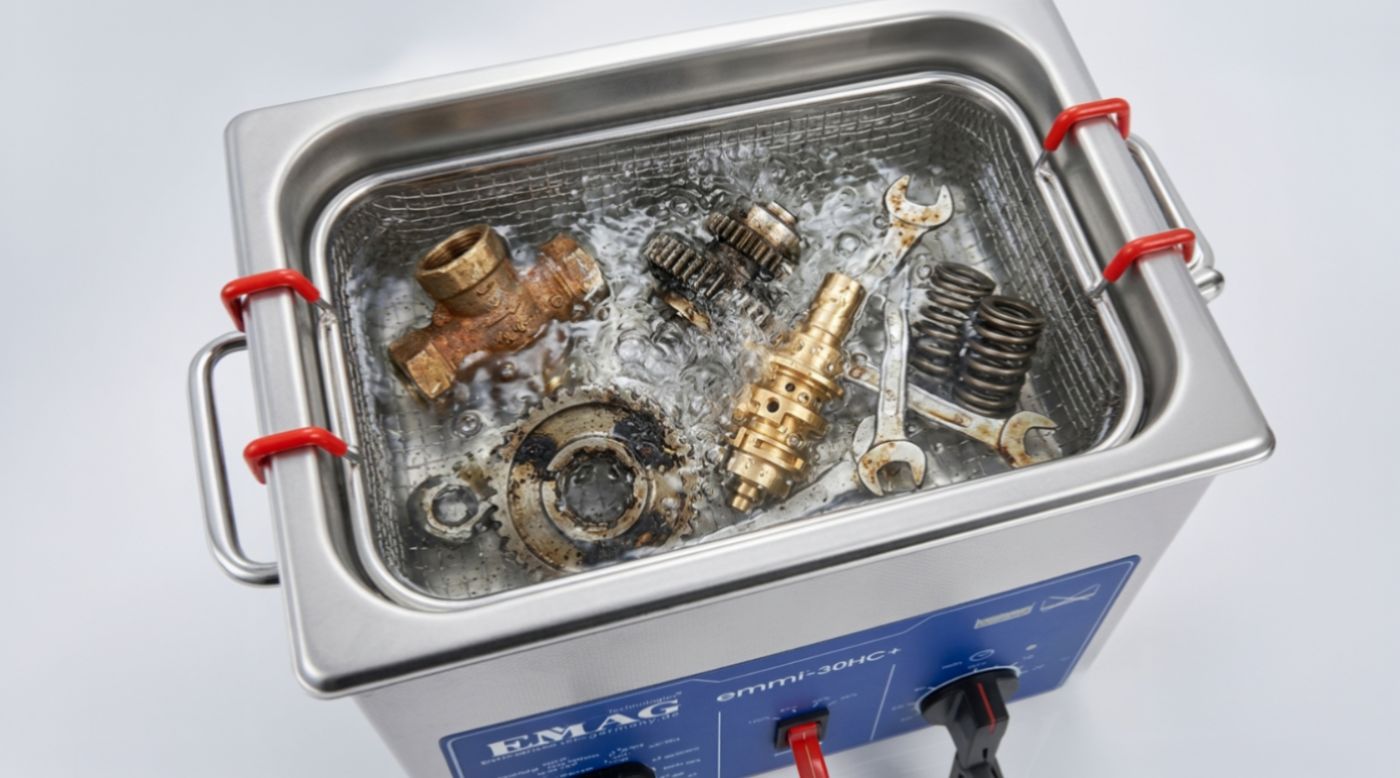
An ultrasonic cleaner generates high-frequency vibrations in a cleaning fluid. This creates tiny bubbles that implode and can thus reach even hard-to-access areas. This process is called cavitation. The resulting forces can help to loosen deposits from surfaces without intensive brushing or mechanical action on the tool.
Especially with complex tools, this can be an advantage, as areas that are difficult to reach with brushes or cloths are also accessed. At the same time, cleaning is often more even because the liquid washes around all areas.
In workshops and industrial companies, professional devices such as our EMAG ultrasonic cleaners are often used for this purpose. Such systems are particularly suitable for metal parts, precision tools, or components with fine structures. However, the appropriate cleaning time, temperature, and cleaning fluid always depend on the respective material and the type of contamination.
It is important to check material compatibility before each cleaning and to observe the manufacturer's instructions. Not every tool and not every material is automatically suitable for ultrasonic cleaning. Sensitive coatings or special materials should always be considered separately.
How to keep tools functional in the long term
Thorough cleaning is only one part of tool maintenance. It is equally important to properly treat and store tools after cleaning. Because even perfectly cleaned tools can quickly become dirty again if they are continuously exposed to dust, moisture, or aggressive environmental influences.
After cleaning, tools should be able to dry completely. Moisture remaining in joints or crevices can promote corrosion in the long run. Afterwards, depending on the tool type, suitable care with appropriate lubricants or corrosion protection agents is recommended. However, more is not always better. Excessive amounts of oil or grease, in turn, attract dust and dirt and can promote new deposits.
Regular visual inspection is also helpful. This allows early signs of dirt, corrosion, or restricted movement to be often detected early. Those who fix small problems in time can often avoid major malfunctions.
Good tool maintenance therefore consists of several building blocks:
- Regular cleaning
- Complete drying after cleaning
- Appropriate lubrication of moving parts
- Protected storage
- Early inspection for wear and deposits
Tools are often used for many years. With consistent care, their performance can often be maintained significantly longer.
Tools do not necessarily have to be replaced if they suddenly become stiffer or lose precision. Often, there is no defect behind it, but an accumulation of residues that has built up over a longer period. Oil residues, dust, metal abrasion, and other deposits can noticeably impair the function of moving parts, even if the tool appears clean externally.
Those who know the typical causes and regularly check can identify many problems early. Thorough cleaning, combined with appropriate care and proper storage, helps to keep tools functional in the long term. Especially with complex or precise tools, it can be useful to include hard-to-reach areas in the cleaning. This way, performance, precision, and reliability are maintained for as long as possible, and the tool is always ready for its next use.